Have you ever unintentionally broken the law?

Once when I was in high school my two older sisters and I decided to drive from Maryland to Maine to stay in a summer cottage of my grandmother’s for Thanksgiving. Sounds like a dumb idea now, but it sounded like an adventure to us then.

The car broke down in a farm town in New Jersey, and while we were waiting for it to be fixed, we walked around this town and passed a field of rotting pumpkins. We saw a good one that we thought we could use for pumpkin pie, so we hopped the fence, got it and walked back to the garage.

Just then, a police car pulled up and the officer asked us why we weren’t in school (I guess students in New Jersey weren’t on Thanksgiving break like we were), and if we were runaways. My oldest sister who was around 23 at the time explained where we were going. He was unconvinced. I guess we looked like trouble.

Then the officer’s eyes lit on the pumpkin I was carrying. “Where’d you get that?” I explained we found it in an abandoned field down the highway. He cited some criminal code and said the field belonged to the Hines company and we were stealing, and he relieved me of the pumpkin.

The fallout was that the car could not be satisfactorily repaired for us to make it to Maine, and the officer said he’d arrest my oldest sister for kidnapping and charge us for stealing and running away if we didn’t turn around and go home.

So a shoddily planned adventure turned into an unexpected brush with the law.

Why I Need Silence

Today in the soothing quiet of the Rec Center pool, an insight bubbled up regarding a life-long pattern. I have always loved silence.

            I am maybe 4, the youngest of 6 at our noisy dinner table. My parents ask questions of each child to find out about our day. This is effortless for the older ones—Becky 6, Dave 9, Mike and Margy 11, and Steve 13. I watch, waiting to be invited in. My mother can tell I have something to say, and calls on me, bidding the others’ attention. “Rachie has something to tell us..”  Even with one or two follow up questions, the polite silence does not feel like attention but interruption. Inevitably, whatever I had to say that day was met with a perfunctory 30 seconds of silence before their conversations resumed.  Looking back on it now, I felt like I was the commercial spot in their much more interesting “regularly scheduled programming.”

            In another memory at 5 or 6: It is spring or early summer. I have dressed myself and stolen outside in the early morning to the swing set in our yard behind the manse, a dewy field of young corn is behind me, the red brick church building my father preaches in is to my left in front of me. I drink in the welcoming silence of the new day. I watch the bats wheeling across the blue, back to the white steeple bell tower; I hear the proverbial early bird, a robin, rifle the ground and pull out a nightcrawler. I witness the small globes of dew hanging like pearls on a spider web. There is much chaos in the house by mid-morning, but at this hour outside I see and feel enfolded in created order. There is room for my voice here. I can speak my thoughts out loud, or remain one with the stillness.

            In this memory, I am 30. I am a young mom now, sitting in my favorite recliner by the window in the living room. I am here with my journal and my Bible, stealing a few moments alone with my thoughts in the early morning before my precious little daughter, 3, and my son, 1 storm the living room and hijack my day. My mother has recently taken her life after years of living with the excruciating pain of schizophrenia. I pour out my pain in rushed cursive into my journal. My sweet little daughter appears in the doorway. Not a storm at all, but a gentle morning breeze. I welcome her into my silence and we sit awhile, as her mind wakes up and I have the privilege of listening to her thoughts before her brother wakes up and we are on with our day.

            This last memory feels like a nightmare now. I am 58. I have stayed too long in a job that doesn’t love me. I am a Special Ed Inclusion teacher, and I have only ever wanted to do what my official title is—to be a co-teacher. In this room, I have been told to sit in the back and BE QUIET. I have been told by the General Ed teacher that my rotating through the classroom during the work period to engage with all students and question them to go deeper is “needling“ them. After the opening lecture, I am ushered across the hall with “my” students with Individualized Education Plans. These students were placed in “co-teaching” General education classes, but my colleague sends us away to be more like a Resource class. I pour into them, the injustice hanging in the air like smoke. Most of them make the best grades in the class, but we are “smelling the smoke”—the injustice. I feel powerless to put out the fire. When I finally tell my colleague he is breaking the law, he gives full vent to his irrational ire. Nothing changes, but my failing health.

            Today, at 64, after a year of retirement, I realize why I got so auditorily exhausted by the end of a “teaching” day. I was required to pay attention to all the noise around me while being banished to silence who I really am. I was a piece of furniture, a complication in the General Education teacher’s day, I was a glorified aide whose judgments even on who to allow to go to the bathroom were second guessed. In short, I was relegated to be treated like the youngest at the table without a voice.

            Now I can bathe in healing silence. I can choose to be with people in structured ways, and I do, or have a tête-à-tête with a friend. I can create characters on the pages of a fledgling novel, or jot poems and reflections in my journal with no interruptions. I can walk the hilly paths of a nearby cemetery in the cool of a morning and remember and re-experience the magic of mattering to God.

Better Than Christmas!

I want to thank those of you who pre-ordered Sister Sorrow. It is my privilege to market my book on Social Media, but it is not, as an introvert, my joy to do so. Years ago, when I had come out of the full time work force to be a first-time mom, I actually became a Mary Kay consultant to try to make ends meet so I could be home with my daughter, and later, son. I learned a lot of valuable lessons about persistence, and the transactional work of business, learned to fight the odds and measure my progress in terms of my efforts, and not in terms of returns (sales), but when I stopped after three years, I said I would never again sell anything I didn’t create. Well, here it is!

I stopped and took inventory, and this book has poems in it that span 37 years–-37 years of reflecting on childhood, grieving my mom’s schizophrenia, and later her suicide, 37 formative years of my life negotiating adulthood, interracial marriage and raising three biracial children in the South, (1981-2013), institutional politics in the work place (an ongoing struggle), and my own seeking to open my mouth and speak in spite of the dysfunctional family rule to NOT talk about emotional struggles and how I was processing childhood trauma, or for that matter, the problem of my mom’s struggles at all. 

Poetry has been God’s gift of healing to me. There, I can say whatever I need to say without being censored, nor self-censoring. I have gravitated to poetry in translation from poets from Eastern Bloc countries who wrote courageous poems of protest and cultural criticism in code. When I thought I was screaming my truth in my poems, I was given feedback early on that my poems were encoded as well, and the most valuable thing I took away from a Steven Dobyns poetry workshop at Vermont Studio Center when I was 35 was that there needed to be a dynamic balance in each poem between tension (arcane or inscrutable imagism) and rest (the well-earned plain-spoken demystifying line). This has become a guiding principle, but not a hard-and-fast rule, since poetry is my sandbox.

Getting 205 preorders for a sight-unseen book of poetry without the benefit of live readings during this COVID pandemic was a tough sell, but various folks in my communities came through. I am so humbled and thankful for you.

I titled this “Better than Christmas,” because the joy of hearing from friends who have finally received Sister Sorrow in the mail, after ordering back in September or October is a brand new experience for me. A few readers have asked me how I had the courage to write about such personal experiences. I could write it a moment at a time, in solitude and in safe community, so the sharing of the whole collection is a new experience, but the writing was my essential life line. The courageous part is admitting it took this long, and that I submitted it over 50 times over 15 years.

And writing IS my lifeline, and the promotion stuff, though a privilege, has been a major creative drain. I was comforted to hear Ann LaMott say as much in several interviews. 

Live readings? Now that is another package I’m looking forward to opening, still under the tree.  Another? Your reviews of Sister Sorrow on Amazon and Goodreads. Leave me a message and I will email you a great outline for a short book review. Now that is a tool to help any author you enjoy, and get more folks reading books.

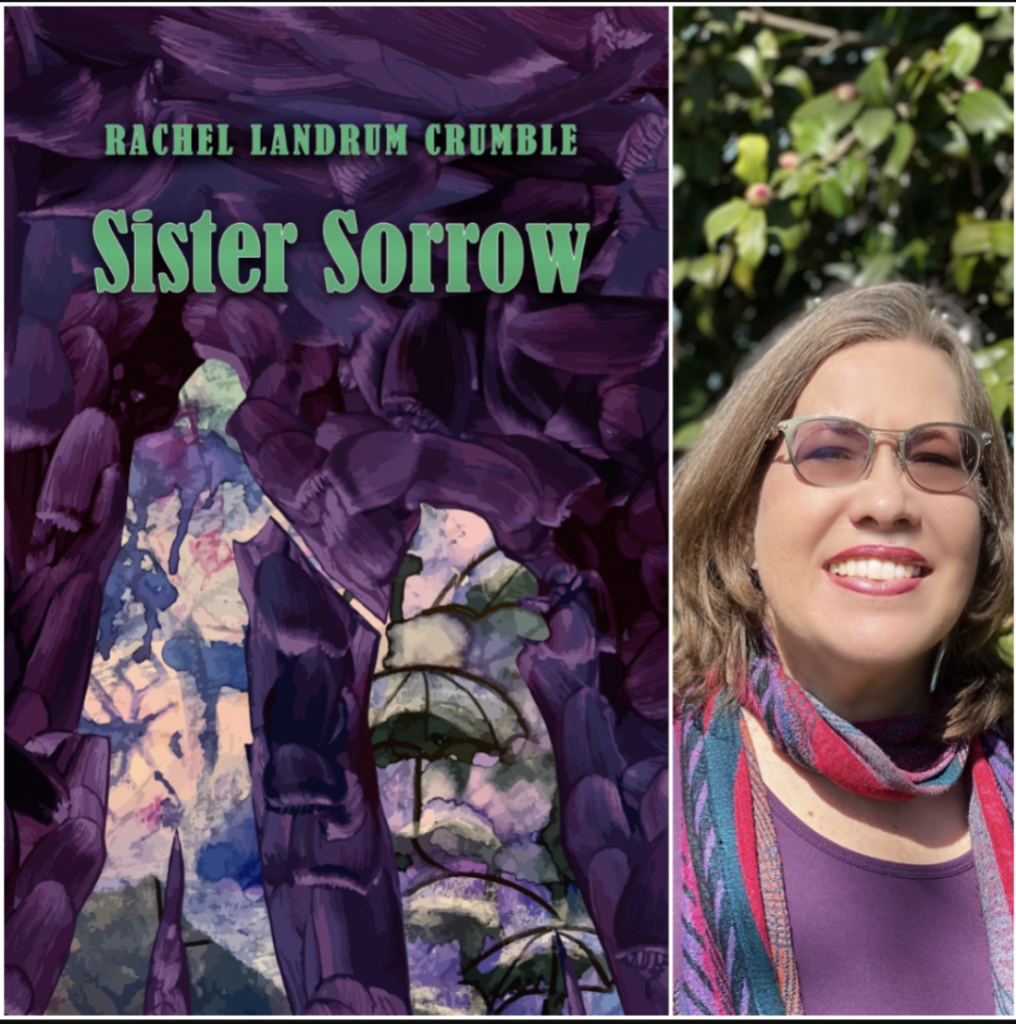
Book shout: Sister Sorrow by Bindweed contributor, Rachel Landrum Crumble

Thank you Leilanie and Joseph for your kind mention of my new book!

Heavenly Flower Publishing's avatarBindweed Anthologies

(Photo of Sister Sorrow by Rachel Landrum Crumble from Finishing Line Press)

Congratulations to Bindweed contributor, Rachel Landrum Crumble on her forthcoming poetry collection,Sister Sorrow, which will be published in January 2022 by Finishing Line Press. Her book is available now on pre-order, so you can buy a copy through the link on the title above.

Rachel has previously contributed poetry to Bindweed. Her poem can be found in Bindweed Issue 9 and read here.

We wish you all the best with your new book, Rachel!

View original post

A 40th Anniversary Google Maps Misadventure: The Story and the Reflection

The Story

            Even three weeks later, retracing where we went wrong on Google Maps is painful. It was approaching our 40th—yes, 40th!—Anniversary, and unlike so many other anniversaries that went by in the blur of end-of-the-school-year activities related to work, or before, to our children, THIS TIME I proposed to my husband that we dignify the occasion and get away for the weekend.

            Granted, this was May 2021, and we had been operating in a diminished radius from our home since the pandemic hit in mid-March 2020, but now we were fully vaccinated, public mask mandates were expiring, and businesses were opening up again, so the prospect of any travel seemed glamorous.

            My husband said he wanted to go to a botanical garden, so I remembered that our friends, another interracial couple, had honeymooned at Calloway Gardens “back in the day,” so I commenced the online planning.

            We finally took off at 4:30 p.m. on Friday afternoon, after requisite delays—our own pathology, but that is an entirely different story. Calloway Gardens was only three hours away. I searched Google Maps for the exact address plus zip code, but found nothing, so returned to search for “Pine Mountain, GA.” (And unbeknownst to us, THIS was where the misadventure began. Did your own navigational skills get a little rusty since the pandemic? I had to think hard just to get to familiar places around our area I hadn’t been at in months.)

            Google Maps took us through the mountains of north Georgia through Ellijay, where we lost phone service, but somehow kept the bewildering turn-by-turn directions, which we felt forced to follow, since we were unable to verify any other way.

            Daylight was waning when we reached Clayton, Georgia. Right before that, we reached Lookout Mountain, Scenic Highway 76, which was a spooky moment, since we thought we had somehow made a loop back to our home in Chattanooga, which is at the foot of Lookout Mountain and Scenic Highway is the through road, but this was an entirely different place and highway.

Totally unmoored, we were relieved that the clerk at the gas station convenience store in Clayton, Georgia was black, the first black person we had seen in miles. He did not know where Calloway Gardens was—a bad sign—but said that if we continued up the mountain road, next to the gas station, we would get to Pine Mountain, and eventually, South Carolina.

            That should have tipped us off right then, but ever-hopeful, devoid of a map, and ignorant of the lay of the land, we headed up the mountain road and took Warwoman Road as instructed. After untold aimless miles on a winding two-lane road to no-man’s land that was only frequented by hunters and fishermen in weather-worn Jeeps, we got to the South Carolina border and turned around. Google Maps had handily declared miles back that we had “arrived” at Pine Mountain, which was quite literally in the middle of nowhere but a pine forest.

            Tensions were mounting by the time we trekked back down the mountain into the welcome of streetlights and phone service in Clayton, Georgia at 9:30 p.m. We inquired again about Calloway Gardens, and a local man filling up his white pickup truck told us it was 600 miles away. Despite our blunders thus far, I suspected hyperbole. I was now wary of second-hand information. I wanted the truth.

My husband declared in exasperation that we were going HOME now. I switched over to a different navigation app, WAZE, and reluctantly plugged in our home address. We were three hours from home. I struck a bargain with my husband that if Calloway Gardens (the OTHER Pine Mountain, Georgia) was closer than home, we would proceed to our original destination. Mercifully, when I typed in the exact address of the hotel, the two locations were nearly equidistant from our present location. Our planned Anniversary Get Away was saved.

As we bypassed Atlanta all lit up at night, I wondered aloud if God wasn’t taking us on a little field trip, which our sheltered-in-place stagnant senses had long been deprived of. We would never have hazarded the back roads of the North Georgia Mountains, or seen Atlanta by night within the same day otherwise. Now that we knew where we were going, we could take a breath, listen to an audio book and have our anxious fears allayed with the sign posts of our progress along the way…

We fortified ourselves twice at pit stops for caffeine and snacks, and finally arrived at the intended destination at 12:30 a.m., 8 hours after we started out. And, yes, after we decompressed from the stress of our Google Map misadventure, the rest of the weekend was lovely just being present to each other and celebrating the gift of 40 years of shared adventures and misadventures.

The Reflection: “I once was lost, but now am found, was blind but now, I see.” What I learned:

1)Unused skills attenuate. 2) I probably impatiently input inexact information, though I tried to do it right (The old adage: Garbage in, garbage out comes to mind.) 3) Knowing the big picture (the whole route) before embarking on anything important prevents gross navigation blunders.

4)The only constant turn by turn instructions we needed was from the Maker of all things, not the maker of our phones! We may shut ourselves off from our power source, but God, unlike internet, is ever-present and intervened.

5) Sometimes, existential experience can lie, like the spooky recurrence of Lookout Mountain and Scenic Highway in a completely different location.

            6)Being lost is no fun. Admitting we were lost felt like death, in the moment. It was mortifying, and we kept looking for vindication. The longer we stayed in denial, the further we strayed from our intended destination.

7) In conflict, compromise and logic saves dignity.  Sometimes, just the perspective that we’ll out live the hurt, and get to a place of being able to laugh at ourselves helps. And let’s face it: God has a sense of humor, so even though it was hard to laugh in the moment, later on, these stressful experiences make for great stories.

8) Owning, instead of blindly outsourcing, the oversight of the journey to a dumb app helped us track our progress. It kept us from further conflict, and finally got us where we wanted to go.

Towards an Aesthetic in Aphorisms and Quotes

noun. English Language Learners Definition of aesthetic (Entry 2 of 2) : a set of ideas or opinions about beauty or art. : the study of beauty especially in art and literature. : the artistic or beautiful qualities of something.
Aesthetic | Definition of Aesthetic by Merriam-Websterwww.merriam-webster.com › dictionary › aesthetic

I have always loved reading about writers’ philosophies of creating. I loved Flannery O’Connor’s aesthetic in Mystery and Manners long before I warmed to her fiction. If I’d read that first, I would have had an appreciation of her American Southern Gothic proclivity to choose the most low-down evil character because she wanted to see how they would respond to the grace of God.

Our age not only does not have a very sharp eye for the almost imperceptible intrusions of grace, it no longer has much feeling for the nature of violences which precede and follow them.

Flannery O’Conner Mystery and Manners:Occasional Prose

As a Christian, I have always resisted the notion of being a “Christian Writer” as that implies writing to a narrow audience and using conventional religious language and formulas for conveying experience. I would rather be a human writer who is free to examine faith and doubt, a fuller spectrum of human experience than the often sanitized experience or pat answers of “Christian [devotional] Writers.” There is something suspect about writing as if one has the truth nailed down in experience. Who can stand a person who has all the answers, and yet denies the questions, the struggles, the existential testimony of what it is like to be fully human, as well as embracing the often enigmatic Truth with a capital T?

Here are some Bible verses that suggest a deeper, wider, broader aesthetic:

  • “In your light we see light.” Psalm 36:9b
  • “The hearing ear and the seeing eye, the Lord has made them both.” Proverbs 20:21
  • “The heart of the wise is in the house of mourning.” Ecclesiastes 7:4
  • “The earth is the Lord’s and the fullness thereof, the world and all who dwell therein.” Psalm 24:1
  • “And he is before all things, and in him all things hold together.” Colossians 1:7 ( so I don’t have to single-handedly make sense of everything at once in a poem or story–that’s what God is for).

Here are some of my own aphorisms toward an aesthetic:

I will question my perceptions, but I will not sanitize my own experience; there is gold in the grit.

  • Truth is full-spectrum light, but I live my life both singularly, and in community, in all kinds of weather.
  • I can’t see what Heaven will be, but for now, I can only see beauty through imperfection.
  • The universal has tiny roots in the particular and the ordinary. Transcendence is found in the mundane, even the inane.
  • I embrace every stage of my development creatively and personally, because I am still in process.
  • I am free to capture moments of time that also document a flawed self and transitory experience that may change tomorrow.
  • I am free to interrogate and love that flawed self as an extension of humanity.

There are many writers and poets I love, but the Swedish poet (and 2011 Nobel Prize winner) Tomas Tranströmer has to be my favorite, for his plain-spoken eloquence. Here are some quotes from his poems that evoke a meaningful aesthetic for me:

Mission: to be where I am.

Even in that ridiculous, deadly serious

role: I am the place

Where creation is working itself out.

“The Outpost,” Tomas Tranströmer Selected Poems translated by Robin Fulton

Concerning politics and propaganda

The following quotes are from several poems in Tomas Tranströmer Selected Poems translated by Robin Fulton. Ardis, 1981

4.

Radical and Reactionary

live together as in an un-

happy marriage,

moulded by one another, dependent on one another.

But we who are their children must break loose.

Every problem cries in its own language.

Go like a bloodhound where the truth has trampled.

–from “About History”

The language marches in step with the executioners.

Therefore, we must get a new language.

–from “Night Duty”

Two truths draw near each other. One comes from

inside, one comes from outside

and where they meet we have a chance to see ourselves.

–from “Preludes.”

(Regarding Tranströmer’s translations, I just found a new favorite in Patty Crane’s translations of Bright Scythe).

What’s is compelling to you? Leave me your thoughts.

Lament: New Years 2021

In the culture of my origin (family culture, and larger white protestant middle class culture), there isn’t much place for lament. I remember looking at National Geographic pictures of people in lament, and even reading about professional mourners. I was puzzled. I lived right next to the church building where my dad was a minister, but my parents felt I was too young to attend the funerals there. I would hold my own sad vigil trying to conjure what it must be like for the pregnant young wife to bury her new husband who died a soldier in Vietnam, or the family of a state government dignitary of some means who passed despite his influence and power…


I first attended a funeral, believe it or not, when I was 18 or 19 and in college in Chattanooga. Some of the kids I taught in an after school and summer reading program through my inner city church had lost their grandmother. People cried, and cried out, and sang their full-hearted sorrow. This seemed more realistic to me. This was lament. I was both moved and humbled to be included in that private space in that small Black Baptist Church.
Ecclesiastes 7: 4 says “The heart of the wise is in the house of mourning, but the heart of fools is in the house of mirth.” That feels apt this New Years 2021. We are still in the middle of so much collective suffering. Maybe white Americans need to learn to lament. If we are viscerally expressing our anguish, maybe it won’t lead to rage.


In the fall, I virtually “attended” an excellent “Healing Racial Trauma” panel discussion by the Cyrene Movement in Boston. From that discussion, came the assignment God gave me that precipitated the poem “Wade in the Water: A Prayer of Lament.” Since lament is visceral, I reflected on painful aspects of racism I have experienced by association as a white woman married to a black man and raising biracial children in the South.


Honestly, it was excruciating to dredge up experiences that I usually tried to minimize as we experienced them, I realize now, so as not to upset my white family members. When we married in 1981, I didn’t want them to think my life would be a daily emergency because I married a black man, and it wasn’t, except when others made it so. We processed it together, and with other black and biracial families, but not with my family.


Just as the epigraph says, it was a difficult but humanizing exercise, in the face of the racial trauma memo finally hitting the fan this past year and the racial protests visibly in mainstream news.


Perhaps one role of the poet in this world is to be a professional mourner, to give form to grieve that others can’t, or need help accessing.

Wade in the Water: A Prayer of Lament
Racism dehumanizes; lament re-humanizes.” Liza Cagua-Koo
Get me out of my Western European
head-space, roiling with cold intellectual argument.
Summon me, O Righteous Savior, back
into my body, my only vessel,
to feel the holy toll the death of each brown mama’s child
exacts from me, whether they slid from my womb, or another’s.
Wade in the water
This razor is so sharp, it draws blood before I can feel pain.
Each tiny cut creates the hemorrhage:
1979
My rookie confusion at a North Georgia State Park when two men
said they’d get shot guns if my future husband and I didn’t leave.
“and take the same roads you came by.”
1981
My mother’s frantic letter sent six weeks before our wedding admitting
to white privilege, with the question: “What about the children?”
1982
The adrenaline anger of my young husband, yanked into a squad car
while walking in our mixed neighborhood, where black still meant “suspect”.
Children, wade in the water.
1987
My heart thumping fear during a contraction
as two white men in a work truck get out and glare
when my husband stops at a gas station on our way to the Birth Center.
2008
It took years for him to tell us how a white teacher whispers
into my brown son’s dreds, before he crosses the stage at graduation:
“Do me a favor. Stay out of jail.”
2013
Seven referrals by one teacher that got my youngest son
put out of the magnet school he had attended since kindergarten.
His Asian and white friends said they were doing the same things

without consequence. The fruitless conferences. In the end, he became
the angry black boy who gets in trouble.
2015
A white principal offers a janitor job to my son’s black friend
and the offense taken when he is turned down,
ignorant of the offense given.
2017
Let me enter the terror of the 3 a.m. call, the slow-mo knock that crescendos
an apocalypse of pain. Let my tears water my own humanity.
2019
An older white man in a posh Southern California shopping district
sees my laughing hoodie-wearing sons, and my beautiful daughter
and pushes my son, who stops, waiting to answer the first blow.
My mama’s heart buries this memory my mind can’t hold.
God’s gonna trouble the water.
2020
Let tender green resilience grow where micro-aggressions and violence
swallowed whole. Let our humanity recognize the image of God
in each other, obliterating centuries of us and them,
restoring objects of fear
to subjects of our own nuanced histories.


Rachel Landrum Crumble
first published in Bluing the Blade December 2020